
Today, for businesses, digital advertising is much more than just visibility; it is about accessing the right audience at the right time in the buying process. Google Ads and Meta Ads dominate the online advertising landscape. Although both are very performant, they operate on fundamentally different sets of principles and produce results based on very distinct strategies.
Selecting the appropriate advertising platform will positively affect business growth. An aligned strategy can help drive qualified traffic, optimize marketing efficiency, and increase profit by optimizing return on ad spend (ROI). However, using the wrong platform, or using only one with an ambiguous strategy, can result in wasted budget and missed growth opportunities.
For example, you might consider Google Ads or Meta Ads and compare them side by side to find out how these platforms are performing better and what kinds of activities you can do strategically, depending on which channel you are using first and second. By the end, you’ll know which advertising channel lines up with your goals most neatly, and when a combination thereof can produce better results overall.
Google Ads Versus Meta Ads: Understanding the Basics
Google Ads and Meta Ads are two strong digital advertising platforms, but they lead to different results depending on the users’ behavior. Google Ads is intent driven, so it attempts to reach users who are currently seeking products, services or solutions.
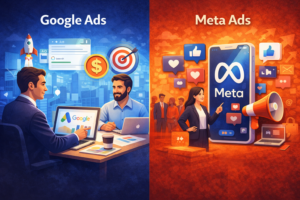
Meta Ads is audience-focused on the contrary, which can reach users who are not searching but are interested in certain things such as interests, behaviors, demographics, and past behavior. Knowing this fundamental distinction is important to businesses on how to use advertising spends and link campaigns with their growth aspirations.
Google Ads: Intention-Driven Lead & Demand Capture
Google Ads is excellent at hitting those people who are naturally already interested in a solution. People show intent when they search for “best accounting software” or “business broker services” and are much closer to making a purchase or inquiry.
This gives Google Ads a lot more power to hit qualified leads and sales and conversions.
Good for Businesses: The Role of Google Ads
Fitting for high-intent users frequently leads to a higher conversion rate.
Targeting by keywords based on customers.
Flexible ad distribution amongst Search, Display, YouTube, and Google Maps.
Great results for lead-generation, eCommerce, and service businesses.
Challenges to Consider (Google Ads)
Increased cost-per-click in competitive business segments.
Needs keyword research and bid optimization work all the time.
Less casual knowledge (which can also lead to more of an expertise for management).
Meta Ads: Awareness, Engagement & Longevity
Meta Ads, spread across Facebook, Instagram, and Messenger, are purpose-built to create awareness, engagement, and longevity. Meta Ads, rather than search intent, attempts to influence prospects earlier in their purchase and keep the brand front and center during the purchasing process.
They are particularly effective for delivering stories, promoting a product, or bringing repeat customers who’ve been exposed to someone.
Benefits of a Meta Ads Strategy
Strong visual storytelling through images and video, reels, and carousel formats.
Data for more advanced audience targeting according to interests, behaviors, and demographics, and personalized data.
Very effective remarketing and retargeting capabilities.
Ideal for brand awareness, promotions, launches, and nurturing demand.
Challenges to Consider (Meta Ads)
Less immediate purchase intent than search-based advertising.
Regular creative testing and content optimization.
Platform and algorithm changes will affect the performance.
Lead Quality & Platform Trust: Which Delivers Better Results?
What Do You Trust Is One Place To Trust More? So Which Is It? Who’s the Better Leads-Deliverer and Which Is More Accurate?
When it comes to inconsistent or unpredictable lead flow, Google Ads works for you; they will often provide quicker, more measurable results. Because users are searching constantly for a certain product or service, the business can create demand at the time when intent is the highest.
With an effective keyword plan, landing pages and conversion tracking in place, you can actually start churning out qualified leads or sales in a matter of days.
Yet not all lead generation is aimed at this end. As a strategy, Meta Ads provides the best creative flexibility and the ability for engagement when its intent is to create brand awareness, inform consumers, provide new products or services, launch an offer or promote a specific time-sensitive promotion.
Meta Ads let business build a point of purchase before the customer is on their journey to the market by staying on, sharing their brand story, and keeping that audience interested over time.
How to Utilize Both Platforms Strategically
How to Utilize both of these for an economical business use of both platforms. Think about how the same types of strategies serve different purposes:
Google Ads can be used by a restaurant or service business to reach users who are searching for words similar to “Italian restaurant near me” or “best catering services,” thereby capturing customers who are already ready for a decision.
The same company can work via Meta Ads to do video and image marketing campaigns featuring food, ambiance, customer experiences, temporary deals—creating awareness, credibility, and trust among a broader audience.
It is also the same model for all types of business:
For instance, a B2B business may employ Google Ads to pinpoint high-intent searches for a particular solution, while utilizing Meta Ads to build thought leadership and position oneself as a brand authority.
E-Commerce brands can employ Google Ads for product-focused queries, and Meta Ads for discovery to increase engagement and encourage repeat purchases.
Budget & ROI: What Works for Your Business?
With small budgets and fewer resources to invest in internal processes—as is the case for lots of burgeoning businesses all over the world—it is a must to put money into media platforms that will deliver tangible returns.
As such, Google Ads tends to give users, instead of passive consumers, who may not be using it, the exact ads that the website’s system is aiming its message at are those that do use the platform specifically, such as for the user is actively looking for the solution. That allows to more directly link ad spend to leads, sales, or questions.
In contrast, Meta Ads is frequently cheaper per impression, so companies can serve bigger groups at lower prices and stretch their budgets even more. Though conversions won’t happen in real-time, Meta Ads are extremely useful in increasing awareness, generating interest, reaching people by reaching out to them, and getting them to buy your product if they can’t.
After all, strong ROI is less about picking one single platform than executing a well-placed strategy. Businesses don’t have to be too careful about this: Knowing your aims, audience, and funnel stage are what businesses look for; they can gauge where to start and how to scale.
By collaborating with an experienced team this can be simplified and the company can see that its ad spend is tied towards long-term growth.
Sustainable & Consistent Growth by Combining Google Ads and Meta Ads
The majority of successful businesses maximize impact using both platforms together: not simply in isolation.
If they develop a singular, unified strategy as well a well thought-through approach, businesses will cut down the guesswork and become more predictable about the approach to grow faster.
Final Ruling: Google Ads Versus Meta Ads
When you compare Google Ads vs Meta Ads, there is no one best-performer. The right approach will depend on your business values, budget, and growth stage.
Google Ads = quick wins, measurable results
Meta Ads = long-term brand, customer retention
An effective digital advertising strategy can have an impact that will get businesses out of uncertainty and inconsistent results. With the proper guidance and execution, online advertising can be an incredibly effective avenue for generating leads, growing sales, and building sustainable businesses.
And if you’re looking to execute a clearer, more predictable growth strategy with the help of digital advertising, expert support can serve as a next step toward confidently scaling your business.
Ready for Predictable Growth?
Having trouble with erratic leads or unstructured marketing efforts?
At Gordon.mt, we help companies that want to grow create purpose-driven, data-driven, and clear advertising campaigns that deliver measurable results.
Organize a free strategy call for you to see how a tailored marketing system can help you achieve the right result, be more effective, and build with confidence.